
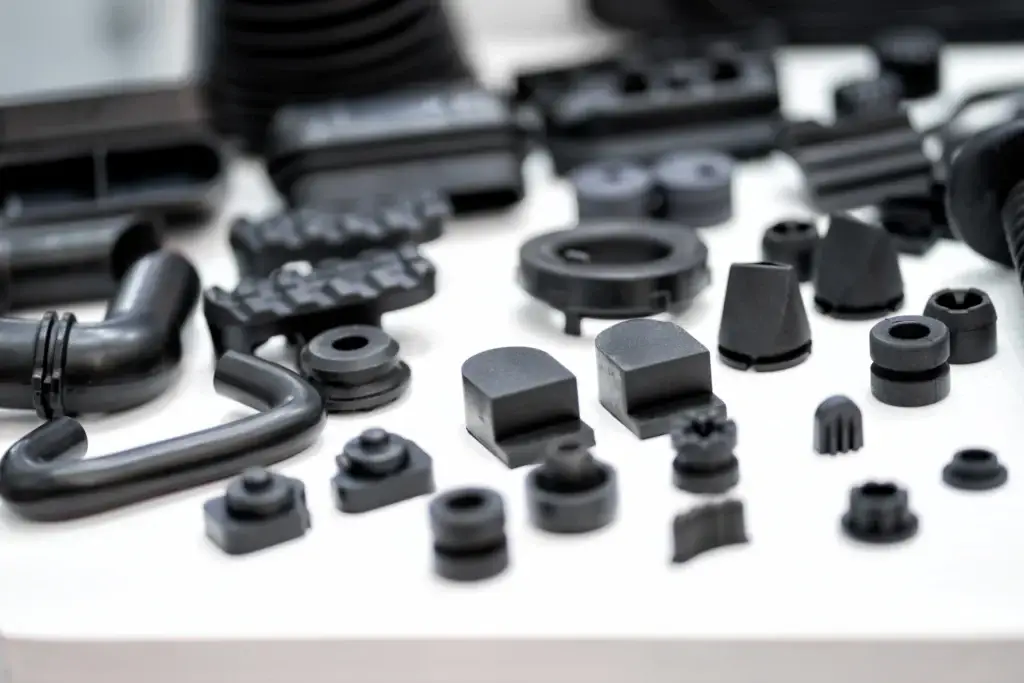
If you’re designing a plastic component, you may already have its shape and function in mind. Choosing its material means considering what it needs to withstand, how it’ll be manufactured and what each finished part should cost.
When it comes to compression moulding, thermosets and fibre-reinforced composites provide options for components that need strength, heat resistance or electrical insulation. There’s no single best material: the right choice depends on your application.
Before comparing them, it helps to understand the terminology. Sheet Moulding Compound (SMC) and Bulk Moulding Compound (BMC) describe forms of moulding compound. Polyester, vinyl ester and epoxy are resin families that can be used within those compounds.
This guide focuses on rigid thermoset materials and fibre-reinforced thermoset composites.
Glass-fibre SMC
SMC combines a thermosetting resin with chopped fibres, fillers and additives in a sheet. Glass-fibre grades are used for parts such as panels, covers and structural housings, where strength and stiffness need to be balanced against weight.
The formulation can also address appearance. If your component will be visible, a surface-finish grade may help you achieve the required finish alongside its mechanical properties.
SMC comes in different grades, which vary in strength, stiffness and surface finish. Your manufacturer can help you choose one that meets your component’s requirements. For example, a grade designed to produce a smooth finish won’t necessarily have the strength or stiffness your part needs to carry its intended loads.
Glass-fibre BMC
BMC is worth considering for smaller components with more detailed features. Also called Dough Moulding Compound (DMC), it’s supplied as a dough-like mixture of resin, reinforcement, fillers and additives.
Conventional glass-fibre BMC typically uses shorter fibres than SMC. Suitable formulations offer electrical insulation, heat resistance and dimensional stability, making them worth considering for housings, insulators and electrical components.
BMC can be compression, injection or transfer moulded. The best process depends on your component’s shape, how precisely its dimensions need to be controlled and how many parts you plan to produce. Your manufacturer should review these requirements with you before you commit to compression moulding.
Phenolic compounds
Where operating temperature is a priority, consider phenolic moulding compounds. Appropriate grades combine heat resistance with dimensional stability and electrical insulation, supporting applications in electrical equipment, automotive systems and industrial machinery.
You’ll still need to define what ‘heat resistant’ means for your part. Continuous exposure, brief temperature peaks and loads applied at those temperatures place different demands on the material.
Tell your manufacturer if your component will face knocks or vibration. Some phenolic grades are formulated to withstand impacts better than others. Fillers mixed into the resin can also affect strength and electrical insulation, so your manufacturer should check that the specific grade meets your requirements.
Melamine-phenolic compounds
If your part needs thermal stability alongside surface hardness, melamine-phenolic compounds offer another route. They combine properties from both resin families and are used for components such as switches, control knobs and thermostat housings.
These compounds can also suit electrical parts that need to resist damage caused by electrical arcs or surface tracking. (Arcing occurs when electricity jumps across a gap. Surface tracking refers to when electrical stress and contamination cause a conducting path to develop across an insulating surface.)
As with phenolic compounds, assess the grade against the application. Surface hardness, impact resistance and electrical performance are separate requirements. Establishing which matters most will help your manufacturer narrow the options.
Vinyl ester composites
Your component may need to withstand chemicals or moisture as well as heat and electrical stress. Contact with water, cleaning products or process fluids can affect which resin is suitable.
Vinyl ester resins are worth considering for these applications and can be used in SMC and BMC formulations. Suitable grades offer resistance to chemical attack and damage caused by water, but their performance depends on the exposure conditions.
To assess a grade for your application, your manufacturer will need to know the substances involved, their concentrations and the operating temperatures. Include exposure times and cleaning conditions too, particularly for fluid-transfer components.
Reinforced epoxy compounds
If your component needs to carry loads while keeping weight down, consider reinforced epoxy compounds. Carbon-fibre systems can provide strength and stiffness in compression-moulded parts with features such as ribs and inserts.
Performance depends on the resin, the amount of fibre and how the fibres are arranged. Carbon fibres also conduct electricity, so tell your manufacturer if your part needs to provide electrical insulation. Your manufacturer should also check whether the grade can withstand your operating temperatures.
Is compression moulding the right process for your component?
Material selection and process selection need to happen together. The materials above give you options to discuss, but your component’s design may favour another manufacturing method.
Injection moulding, for example, might be a better fit for detailed thermoplastic components produced in larger quantities. Automated production can help control the cost per part, although tooling costs and your expected quantities still need to be assessed.
Choosing a thermoset doesn’t automatically mean choosing compression moulding either. Suitable BMC and phenolic grades can also be injection or transfer moulded. Transfer moulding may suit detailed thermoset parts with moulded-in metal inserts.
Ask your manufacturer to compare suitable materials and processes against your part’s function, dimensions, production quantities and total manufacturing cost before you settle on an approach.
Get manufacturing input before finalising your design
You don’t need a finished drawing, a selected material or a chosen manufacturing process to start a conversation. Share your concept, loads, environment, expected quantities and budget with Talisman Group.
Through design and tooling support, we help you assess materials and manufacturing options while your design can still be adjusted.
Contact our team to discuss your component and establish which material and process suit your project.