
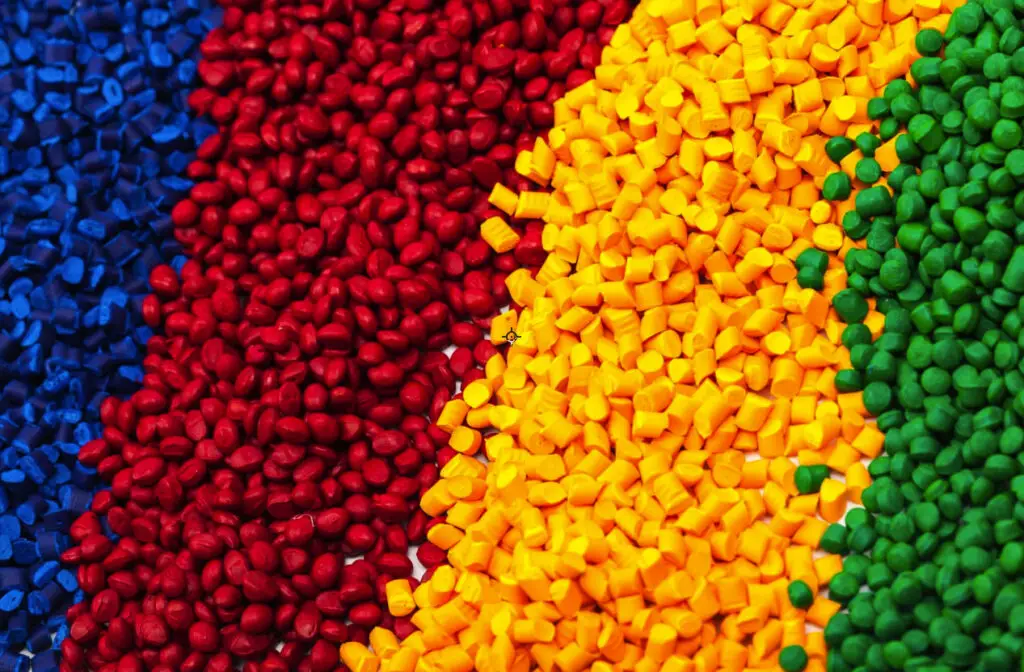
Regrind plastic is plastic material that has already been processed and then ground down so it can be used again in manufacturing.
In plastic moulding, regrind often comes from excess plastic created during production. Instead of being treated as waste, suitable material can sometimes be collected, ground into smaller pieces, and reintroduced into the manufacturing process.
From a sustainability perspective, this sounds wonderful. However, regrind plastic isn’t automatically suitable for every injection-moulded product. On this page, our team explains in more detail what regrind plastic is, how it compares with virgin plastic, and when to choose each option.
What does regrind plastic mean?
As mentioned, regrind plastic means processed plastic that has been ground down for potential reuse.
In injection moulding, molten plastic is injected into a mould to form a finished part. During that process, there may be extra plastic left over from runners, sprues, test shots, rejected parts or production set-up.
In compression moulding, plastic material is placed into an open heated mould cavity, then compressed into shape as the mould closes. If thermoplastics are being used, there may also be excess material, trimming waste, test pieces or rejected parts from the process.
If this material is clean, separated and suitable for reuse, it can be collected and ground into smaller pieces. These are known as regrind.
Regrind plastic has already been through at least one processing cycle, meaning it may have been exposed to heat, pressure, shear, moisture or handling. But that doesn’t mean regrind is automatically poor quality. It does, however, become an important consideration when assessing whether reintroducing regrind could affect your product’s quality.
How is regrind plastic made?
We’ve already mentioned that regrind plastic is made by collecting leftover plastic that would otherwise be treated as waste and grinding it down. There are a few more details worth knowing.
Before it can be reused, the material needs to be kept clean and separated by polymer type. In simple terms, the process usually works like this:
- Waste plastic material is collected from manufacturing runs
- Unsuitable or contaminated material is removed
- The plastic is sorted by material type (and sometimes colour)
- The material is ground into smaller flakes or granules
- The regrind is checked before being reused or blended
The quality of the regrind depends on how well this process is controlled. Without good control measures, mixed plastics, moisture, dirt, metal fragments, labels, dust or degraded material may reduce how well the finished product meets your standards.
How does regrind plastic compare with virgin plastic?
Virgin plastic is new material that hasn’t been moulded before. It is usually supplied as fresh resin pellets with a known formulation. That means it has predictable properties and no previous moulding history. This makes it useful when a product needs to be consistent, strong or stiff, with a precise colour, a clean surface finish, tight tolerances or clear material traceability.
Although regrind plastic can offer sustainability benefits, it has already been processed. That makes it more variable. Repeated heat cycles, moisture, contamination or mixed material sources affect how the plastic flows, moulds, looks and performs.
Virgin plastic is generally the more predictable choice. Regrind, which is often mixed with virgin in the production process, can be suitable in the right application. But it needs tighter control measures. Its quality depends on its source, processing history, storage and how much you reuse.
Why use regrind plastic?
Regrind plastic is used to reduce waste, improve material efficiency and, sometimes, to reduce material costs.
However, you shouldn’t choose regrind because it’s recycled or potentially cheaper. The product still needs to perform as your design intends. If regrind causes quality problems, rejects, inconsistent appearance or product failure, it can quickly become more expensive than using virgin plastic.
When is regrind plastic suitable?
Regrind plastic may be suitable when the material source is known, the quality is controlled and the finished product doesn’t require properties that could be affected by reprocessing.
It can be a good option for certain non-cosmetic, non-critical or lower-risk parts where small variations in appearance or material behaviour are acceptable. Its suitability depends on several factors, including:
- The type of plastic
- The percentage of regrind used
- Whether the regrind is clean and separated
- The product’s strength requirements
- The required surface finish and colour
- The working environment
- The design specification
- The compliance requirements
- Whether the part is safety-critical or regulated
What types of plastics can be used as regrind?
As discussed, it depends on much more than the material. However, clean, single-source thermoplastics are usually the easiest to reuse. These include materials like PP, PE, ABS and some synthetic polymers. They can naturally be melted and moulded again, so they’re the best candidates for regrind.
More technical plastics can still be reused in some cases, but they need more care. These include materials like nylon, polycarbonate, PET, PBT and glass-filled plastics. They can be more sensitive to moisture, heat, fibre damage, colour variance and performance changes.
Thermoset plastics are different. They usually aren’t suitable for normal regrind use because they don’t melt and mould again like thermoplastics.
When might virgin plastic be the better choice?
Virgin plastic may be the better choice when your product needs maximum consistency, traceability, appearance or performance. In other words, when quality is more important than sustainability.
Virgin plastic may also be preferred for regulated sectors. If a product is used in food, drink, medical, hygiene-sensitive, electrical or safety-related applications, the material may need to meet specific standards, declarations, testing requirements or customer approvals.
In these cases, regrind is not necessarily impossible, but it must be handled with greater caution. The source, documentation, percentage, contamination risk and suitability for the intended application all need to be checked.
If you’re developing an injection-moulded or compression-moulded product and want advice on material choice, ask Talisman Group. Our team offers design and tooling services to help you review your options, refine your design, and achieve your production goals. Get in touch today for a free consultation.