
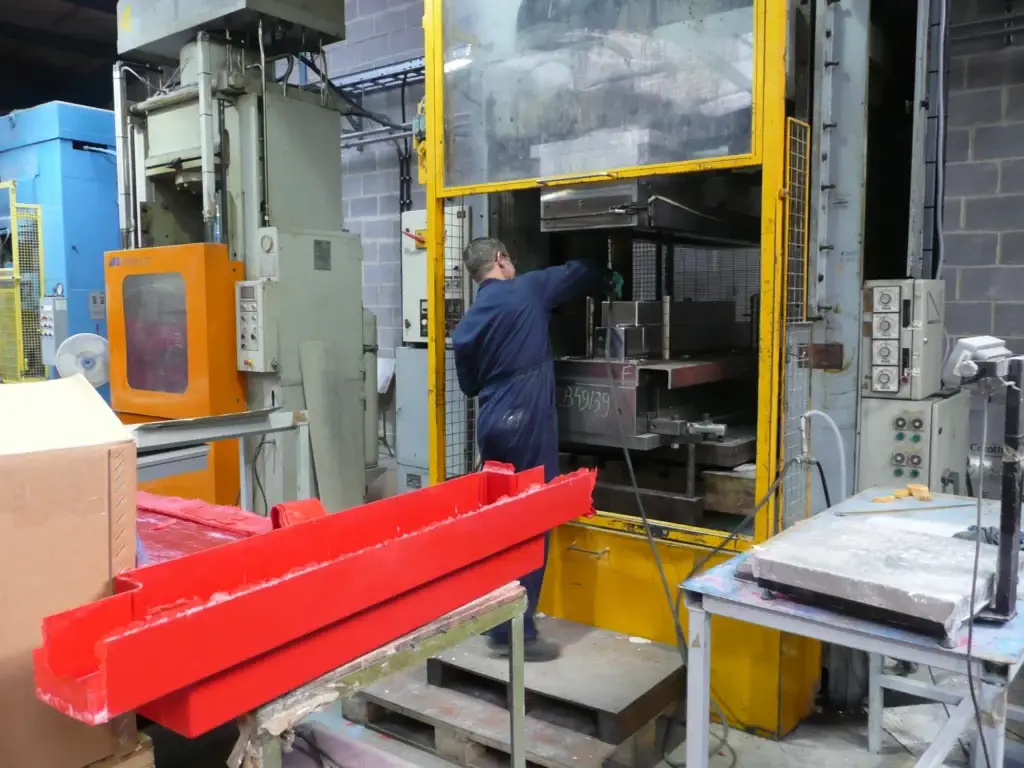
Compression moulding uses heat and pressure to form a measured charge of thermoset or thermoplastic material, including fibre-reinforced composites, inside a mould. With careful planning, it can provide several sustainability benefits to your organisation.
However, compression moulding isn’t automatically sustainable. Its environmental impact depends on material selection, component design, energy use, production method, transport and end-of-life plan.
Talisman Group considers these factors throughout the development process, helping you balance performance, cost and environmental impact. This blog explores some of the main ways compression moulding can support your sustainability goals.
What is compression moulding?
Compression moulding starts with a pre-measured amount of material, usually a thermoset plastic or composite, placed directly into a heated mould cavity. Once the mould closes, pressure forces the material to flow and fill every part of the cavity before it cures into its final shape.
Because the material cures under heat and pressure, you end up with parts that are dimensionally stable and resistant to warping, even in demanding conditions. It’s a process particularly suited to components that need strength, heat resistance and long-term durability, from small electrical insulators to large structural parts.
Unlike some other moulding methods, compression moulding doesn’t restrict wall section variations, so you can produce complex, large-format components without compromising quality. This flexibility, combined with the properties of thermoset and composite materials, makes it a reliable alternative to metal or die-cast parts, particularly where weight, cost or environmental impact are part of the equation.
Reducing material waste during production
Because the material goes directly into the mould, compression moulding can avoid the feed-system waste associated with conventional injection moulding processes that use cold-runner systems.
Compression moulding can also create near-net-shape components, limiting the machining and material removal required after moulding.
Of course, some waste may still come from flash, trimming, rejected parts and charge preparation. Accurate charge sizing, placement and process control are key to minimising waste.
Using reclaimed composite materials
Compression moulding can process recycled polymers and reclaimed composite materials that might otherwise be difficult to reuse.
Your manufacturer may be able to convert thermoplastic composite scrap or uncured prepreg offcuts into charges for new components. Thermosets, which are commonly used in compression moulding, set permanently during curing. Once cured, they can’t be melted and remoulded.
Some compression-moulding compounds can also incorporate recycled polymers and recovered fibres or particulate fillers. The recycled content must still provide the strength, stability, surface finish and chemical, thermal or wear resistance your application requires.
Material testing helps you identify where reclaimed feedstocks can replace virgin material without shortening the component’s useful life.
Retaining more value from reinforcement fibres
Some composite recycling methods grind waste into small particles before it can be reused. This shortens the reinforcement fibres and may reduce the strength and stiffness of the resulting material.
Compression moulding can sometimes process larger pieces of composite scrap, reducing the amount of fibre shortening involved. Retaining longer fibres or sections of the original reinforcement structure may preserve more of the material’s mechanical performance.
The results depend on fibre length and orientation, resin condition, material distribution, consolidation and charge flow. Your manufacturer must carefully design and test the reclaimed material before using it in production components.
Supporting natural-fibre and lower-impact materials
You can use compression moulding to produce components containing flax, wood, bamboo and other plant-based fibres.
These materials may replace part or all of conventional glass-fibre or carbon-fibre reinforcement – where they provide the required performance.
Manufacturers may also combine them with recycled thermoplastics to make use of both renewable and recovered feedstocks.
Natural fibres may reduce the environmental impact of a composite in suitable applications, but they aren’t suitable for every environment. You must account for moisture absorption, dimensional stability, temperature, durability and resin compatibility.
Enabling lightweight composite components
Fibre-reinforced compression-moulded materials can provide high strength and stiffness at a lower weight than some metal alternatives.
A lighter component can reduce energy use when it forms part of a vehicle, train or other moving system. Weight reduction may lower transport and handling demands and, in some designs, reduce overall material use.
However, lightweighting shouldn’t be your only goal. Producing some high-performance fibres requires considerable energy. You should compare the material’s manufacturing impact with the energy and emissions that the lighter component may save during use.
Extending the component’s service life
Sustainability isn’t only about manufacturing emissions, recycled content or production waste. A component that performs for longer won’t need to be repaired or replaced as often. This can substantially reduce the component’s lifecycle impact.
Depending on their formulation, compression-moulded thermosets and fibre-reinforced composites can provide heat resistance, chemical resistance, corrosion resistance, electrical insulation and load-bearing performance. These properties make them suitable for demanding automotive, rail, electrical and electronic, fluid-transfer and industrial applications.
You can develop a component around its actual operating conditions by selecting the appropriate resin, reinforcement, additives and wall thickness. This can reduce the need for replacement parts and the associated manufacturing, transport and maintenance.
Develop a more sustainable compression moulding process
As you’ll have noticed, all these compression moulding sustainability benefits depend on informed decisions throughout development and production.
Talisman Group supports you from initial material selection and design for manufacture through to tooling and full-scale production. We specialise in both injection and compression moulding, allowing our team to recommend the process that suits your component rather than relying on a single manufacturing method.
Across three UK manufacturing sites, we combine more than 85 years of moulding expertise with ISO 9001-certified quality management systems. Our wider capabilities include CAD design and simulation, 3D-printed prototyping, tool testing and approval, secondary machining, specialist coatings, assembly and custom packaging.
Get in touch with our team to discuss how we can develop a compression-moulded component that balances sustainability, performance and cost.