
The best way to choose between compression moulding and injection moulding is to start by identifying the material your component needs. Your material choice depends on what your component needs to withstand, how it will be used and its required service life.
Once you identify the required material properties, you can usually narrow down the most suitable moulding process.
However, material isn’t the only consideration. Your manufacturer will also need to assess several other factors. On this page, we walk you through the most straightforward way to choose between compression moulding and injection moulding, and when to ask the experts.
What’s the difference between injection moulding and compression moulding?
Compression and injection moulding solve different problems, and choosing between them comes down to your material, your part shape and your production volume. Injection moulding suits high-volume thermoplastic parts. Molten material is injected into a mould under pressure, so you get fast cycle times, tight tolerances and repeatable results across thousands or millions of units.
Compression moulding works differently. Pre-measured material goes into a heated mould, and pressure forces it to fill the cavity as it cures. This makes it the better choice for thermosets and composites, materials that can’t be remelted once cured, giving you exceptional rigidity and heat resistance. It also removes the wall section restrictions you’d hit with injection moulding, so you can produce larger, more complex parts without compromising strength.
If your priority is volume and precision, injection moulding usually wins. If you need durability, fire resistance or scale beyond what injection tooling allows, compression moulding is often the stronger fit.
The most important decision is the material
Start by defining what your finished component needs to do. For example, it may need to provide:
- Mechanical strength
- Impact resistance
- Heat resistance
- Electrical insulation
- Fire performance
- Chemical resistance
- Dimensional stability
- Low weight
- A smooth or premium-quality finish
- Compliance with industry standards
For example, an electrical component used near heat may need a thermoset material that provides insulation and remains stable at high temperatures. A high-volume casing may suit a thermoplastic that provides impact resistance, consistent dimensions and a clean finish.
You also need to consider the specific material grade. Materials within the same family can offer different levels of strength, heat resistance, flexibility, reinforcement and chemical resistance.
Work with an experienced moulding manufacturer like Talisman Group. We’ll help you compare suitable compounds long before you commit to a process or component design.
Choose the moulding process based on the material
In most cases, compression moulding processes thermosets and fibre-reinforced compounds, while injection moulding processes thermoplastics. Injection moulding can also process certain thermosets.
Although this isn’t an absolute rule, it gives you a helpful starting point and points you towards the right process for most components. As we’ll discuss later on this page, the final choice also depends on the required shape, tolerances and quantities.
When to choose compression moulding
Compression moulding often suits thermoset materials and fibre-reinforced composites, including:
- Phenolic compounds
- Epoxy compounds
- Polyester compounds
- Sheet moulding compound (SMC)
- Bulk moulding compound (BMC)
- Fibre-reinforced thermosets
During compression moulding, the manufacturer places a measured charge into a heated mould. The tool closes and applies pressure, causing the material to flow into shape and cure.
Thermosets cure permanently during moulding. They don’t remelt when reheated.
Compression moulding may suit your component when it needs:
- Heat resistance
- Electrical insulation
- Fire performance
- Strength and stiffness
- Stability under load
- Thick or varying wall sections
- A large component or surface area
- Reinforcement with glass or other fibres
- Moulded-in inserts or mounting points
Compression moulding alone doesn’t automatically make a component strong or heat resistant. Performance depends on the resin, reinforcement, component design, fibre distribution and moulding controls.
When to choose injection moulding
Injection moulding most often suits thermoplastics, including:
- Polypropylene
- Polyethylene
- ABS
- Polycarbonate
- Nylon
- Polyoxymethylene
- Thermoplastic elastomers
During injection moulding, the machine heats and melts the thermoplastic material and injects it into a closed mould. The material cools and solidifies before the tool opens and ejects the component.
Injection moulding may suit your component when it needs:
- Thin or consistent wall sections
- Fine details
- Complex shapes
- Clips, bosses, snap-fits or locating features
- Consistent dimensions
- A consistent surface finish
- Short production cycles
- Medium- or high-volume production
- Limited trimming or finishing
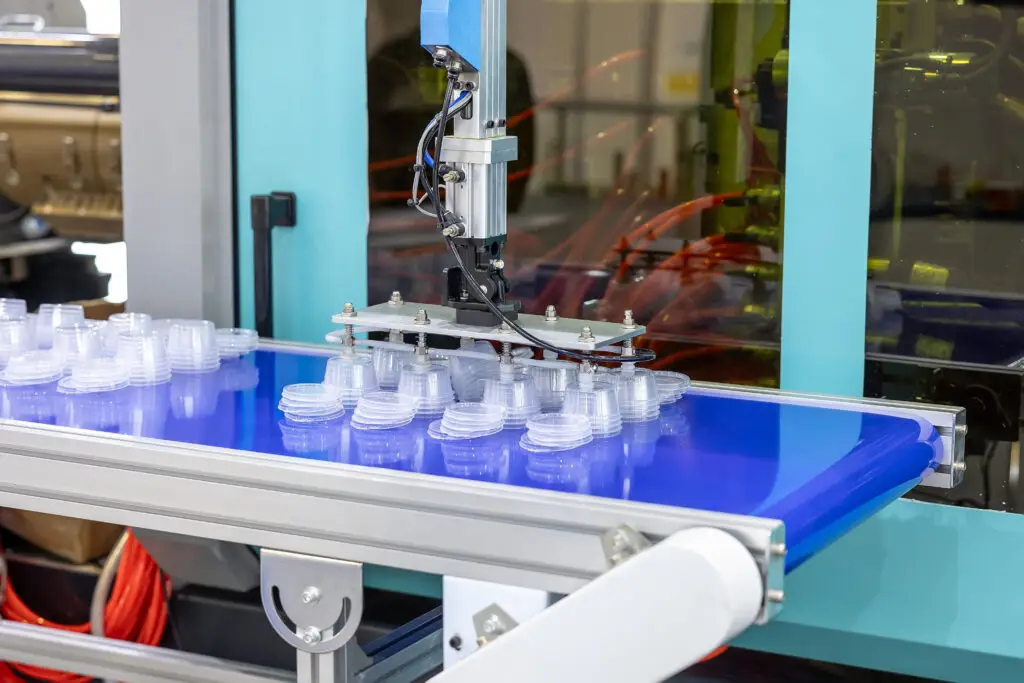
Injection moulding is well suited to automated, high-volume production and a multi-cavity tool can produce several identical parts in a single cycle. These faster production cycles and automation can bring the cost per part down at higher production volumes.
Material isn’t the only consideration
Material choice is a very effective way to narrow down your options, but your manufacturer still needs to confirm whether the component is suited to the process. They will help you consider the following, all of which can affect the choice between compression moulding or injection moulding:
- Component size
- Shape and complexity
- Wall thickness
- Changes in section
- Tolerances
- Surface finish
- Load direction and stress points
- Annual production volume
- Production rate
- Tooling investment
- Target unit cost
- Inserts and assembly
- Trimming and finishing
- Testing requirements
- Future design changes
Even your component’s design can affect the choice between these processes. For example, injection-moulded parts generally need consistent wall thicknesses and suitable flow paths. Compression-moulded parts may require design or tooling adjustments to improve charge placement, material flow, venting and fibre distribution.
You should therefore involve your manufacturer well before finalising the material, design or tooling.
Order compression or injection moulding from Talisman Group
Talisman Group provides compression moulding and injection moulding across our three UK manufacturing sites in Crewkerne, Malvern and Rochester.
Because we offer both processes, we can assess your component based on its material, function, design, production volume and cost requirements. You benefit from more than 85 years of moulding expertise across sectors including automotive, rail, electrical and electronic, and fluid transfer.
Contact our team with your specifications, drawings, operating conditions and required quantities, or even just a list of requirements if you’re early in the design phase. We’ll support your project through material selection, design input, tooling, moulding, assembly and production.