
Composite materials enhance compression moulding by improving both the manufacturing process and the performance of the finished component.
Rather than using an unreinforced polymer, compression moulding can use a carefully developed combination of resin, reinforcing fibres, fillers and additives. Each serves a specific purpose, such as improving strength, controlling shrinkage or supporting material flow.
The result is a strong, lightweight, dimensionally stable component that can be produced efficiently and consistently.
At Talisman Group, we often recommend composite materials when they’re the right fit for the component and its intended application. On this page, we explain the benefits they can offer.
Composite materials improve strength without unnecessary weight
Reinforcement is one of the main benefits of composite materials. The resin forms a matrix that binds the material together, while the fibres carry much of the mechanical load. This allows compression-moulded composites to deliver greater strength and stiffness than unreinforced polymers, without the weight associated with many metal alternatives.
The material’s performance depends on several factors, including the fibre type, length, quantity, distribution and orientation.
Glass fibres provide a cost-effective improvement in strength, stiffness and impact resistance, while carbon fibres can offer even greater stiffness and lower weight if your application justifies the additional cost.
Randomly distributed chopped fibres can give your component more balanced performance in different directions, while aligned or continuous fibres add extra strength along specific load paths, the directions in which the component experiences the greatest forces. This means you can tailor the composite to the forces your component will face in use.
Compression moulding can retain longer fibres while forming complex features
Compression moulding is particularly well suited to long-fibre, sheet and mat-based composite materials. Unlike injection moulding, the material doesn’t have to pass through a narrow nozzle, runner and gate system before reaching the cavity. This shorter, less restrictive flow path can significantly reduce fibre breakage.
Preserving fibre length matters because excessive breakage can reduce stiffness, impact resistance, fatigue performance and overall strength.
In compression moulding, the material is instead placed directly into the heated mould as a measured quantity of material, known as the charge. As the press closes, the charge flows, compresses and forms into the required shape.
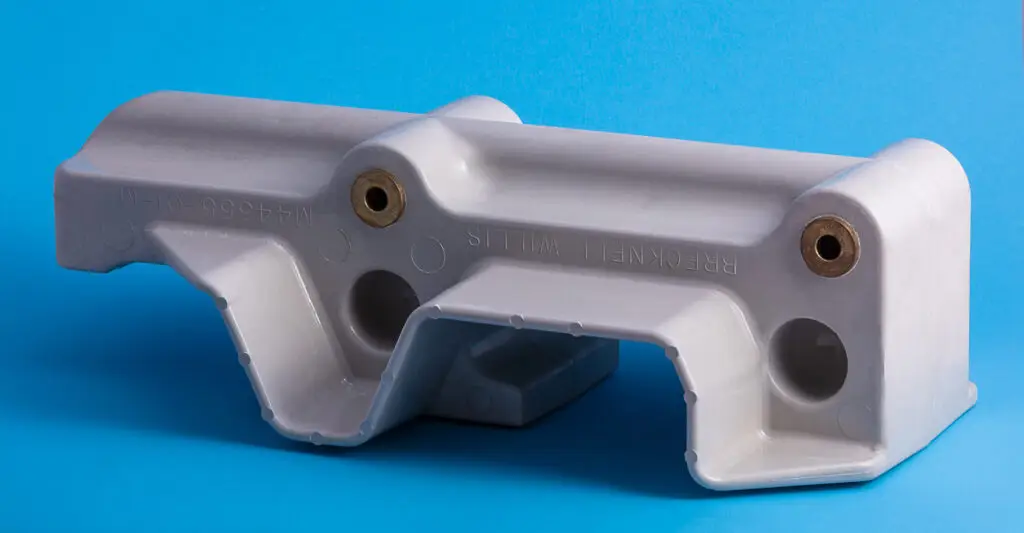
A well-designed composite charge can flow into reinforcing ribs, raised mounting features, flanges, curves and changes in section thickness. This allows you to combine several functions within one moulded component, reducing the need for separate reinforcing pieces, additional fasteners or secondary assembly.
However, fibre-reinforced materials need to flow through the mould in a controlled way. Too much movement can alter the fibre direction or create uneven areas of resin and reinforcement. Careful control of the charge position, temperature, pressure, mould-closing speed and cavity design helps the material fill the mould without reducing its strength.
This makes compression moulding suitable for materials such as sheet moulding compound (SMC), bulk moulding compound (BMC), long-fibre thermoplastics, prepregs and other fibre-reinforced systems.
Heat and pressure improve consolidation
Heat brings the resin into the correct processing state so the charge can flow into the detailed areas of the mould. Pressure then compacts the material, distributes the resin through the reinforcement and helps remove trapped air.
This process is known as consolidation. Effective consolidation creates a dense, unified structure in which the resin coats the fibres evenly, allowing forces to transfer effectively between the resin and reinforcement. Poor consolidation can leave voids or areas with insufficient resin, creating weak points that may reduce strength, encourage cracking or allow moisture to enter the material.
The pressure must be carefully matched to the material and component design. Too little pressure may leave voids or incompletely filled features, while too much can cause excessive flash (material squeezed out around the mould edges) as well as resin loss, fibre movement or uneven fibre distribution.
Component geometry, charge design, material formulation and the required surface finish all influence the correct combination of temperature, pressure and processing time.
Composite formulations can be tailored to your application
One of the biggest advantages of composite materials is that you can adjust the formulation to suit what your component needs to do. Changing the resin, fibre type, fibre content, fillers and additives means you can target specific requirements such as strength, stiffness, heat or flame resistance, electrical insulation, moisture resistance and dimensional stability.
Fillers and additives can also help control shrinkage as the material cures or cools, reducing the risk of warping, sink marks and dimensional variation. This gives you a component with more consistent dimensions, a smoother surface and a reliable fit with neighbouring parts.
So, rather than choosing a standard material and adapting your design around its limitations, you can develop the composite around the component’s operating conditions and performance requirements.
Develop the right compression moulding solution
The right composite formulation can improve strength, stability, mould filling and finished component accuracy. However, achieving those benefits depends on matching the material to your component design, tooling and production requirements.
At Talisman Group, we support the wider development process as well as manufacturing the finished component. Our injection and compression moulding capabilities allow us to assess which process, or combination of processes, is most appropriate for your project.
We can also support design development, material selection, CAD and 3D modelling. Plus, our additional machining, coating, assembly and packaging services can simplify your supply chain by keeping more of the work with one manufacturing partner.
Contact Talisman Group to discuss your component and find out how we can develop a practical, reliable, and cost-effective compression moulding solution around your requirements.