
Food packaging gets scrutinised like almost nothing else in manufacturing.
The materials, processes and handling all matter, because the end-product ends up in direct contact with what people eat and drink.
So, when specifying plastic components for food and beverage applications, the safety question comes up often.
While injection-moulded parts can absolutely be food-safe, they aren’t automatically food-safe just because you use injection moulding.
Whether a plastic is food-safe depends on the material (including its additives and colourants), production controls, handling processes and, of course, the way in which the component will be used. For instance, a plastic part for dry food packaging may have very different requirements from a component exposed to heat, oils, acids, cleaning chemicals or long-term food contact.
At Talisman Group, we support food and beverage packaging projects with custom material selection, precision injection moulding and controlled manufacturing processes. Our injection moulding facility is also BRCGS – Packaging Materials certified.
On this page, our expert team explains what makes injection-moulded parts food-safe, and how to ensure a food-standards-compliant component.
Can injection-moulded plastic be used with food?
Injection-moulded plastic is widely used in food and beverage applications. For example, it can be used to manufacture packaging components, caps, closures, trays, containers, scoops, dispensers, housings and more.
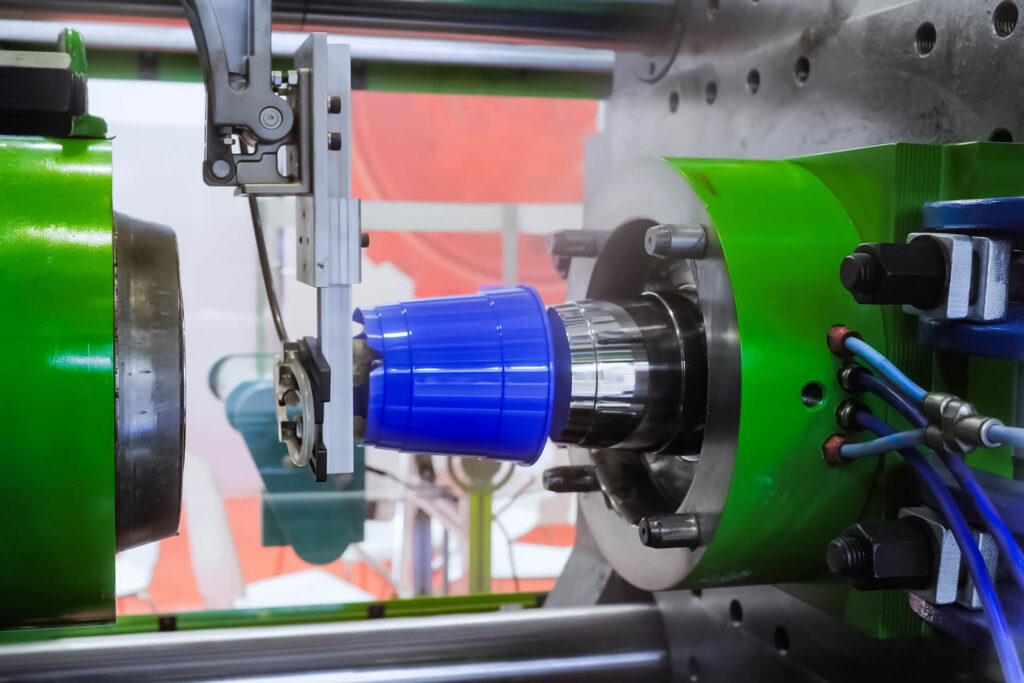
Injection moulding works by heating plastic material, injecting it into a mould tool, cooling it, and ejecting the finished part. This produces accurate, repeatable, high-quality components. But whether the finished part is suitable for food contact depends on your material selection and manufacturing controls.
What makes an injection-moulded part food-safe?
A food-safe injection-moulded part is suitable for its intended food-contact use. That means it shouldn’t contaminate the food, transfer harmful substances, or fail under whatever conditions, such as heat, cold, acid, oil, moisture, cleaning processes or storage, it will face.
Here are the main manufacturing considerations that affect whether your part is food-safe:
Material selection
Some plastic grades are made for food-contact applications. Others aren’t. For example, ‘polypropylene’ only describes the polymer family. The specific grade relates to the manufacturer’s exact material formulation, usually shown as a product code or trade name, such as a named PP homopolymer or copolymer grade. One PP grade might be suitable for a food tub or bottle cap, while another might be designed for automotive or electrical parts.
Additives and colourants
Additives and colourants are extra ingredients mixed into the plastic before moulding. For example, a manufacturer may add a colour masterbatch to make a part blue, a UV stabiliser to help it resist sunlight, or an impact modifier to make it tougher. These ingredients become part of the finished plastic, so they also need to be suitable for food contact. It isn’t enough for the base plastic to be compliant if the colourant or additive isn’t.
Production process
Food-contact components need to be produced, stored and handled in a controlled way. For injection-moulded food-contact parts, the manufacturer may need to manage material storage, machine cleanliness, tool condition, packaging and handling to reduce the risk of contamination.
Evidence for compliance
You may also need documents and records that show the material or finished part is suitable for its intended food-contact use. Depending on the application, this may include material datasheets, supplier declarations, food-contact compliance statements, batch traceability and migration testing.
Why material selection matters for food-safe injection moulding
The material is one of the most important decisions in any food-contact injection moulding project. Common plastics used in food-contact applications can include polypropylene, polyethylene, PET, and certain specialist engineering plastics. However, as we mentioned above, the material family alone doesn’t prove that the product is food-safe. You need to choose a grade that matches your application.
For example, your part may need to withstand chilled or frozen temperatures, hot filling, contact with oils or acidic foods, or have specific colour requirements. A poor material choice leads to significant problems like cracking, warping, contamination risk, chemical migration or failure during use. That’s why we provide custom material selection for food and beverage packaging projects.
What should you tell your injection moulding supplier?
Food safety depends on how you’ll use the part. When you go to your supplier, you’ll need to have a good understanding of how your part will be used.
- Will it directly touch food?
- Will it touch dry, wet, oily, acidic or alcoholic products?
- Will it be used hot, cold, frozen or at room temperature, or across several conditions?
- Will it be washed and reused?
- Will it need to hold its shape under pressure or load?
- How long will a consumer expect it to last?
- What market or regulatory region will it be sold in?
All your answers to these questions (and many more) will affect your material choice, tooling decisions, production controls and compliance. The clearer and more detailed your specification, the easier it is to select the right material, control the process and avoid future problems.
Some manufacturers, like Talisman Group, will help you design and choose the right materials for your food-safe product. This makes the process much simpler for your team. Get in touch to learn more about our design support.
Why controlled manufacturing is important for food-safe injection moulding
Food safety isn’t just about the material. It’s also about how the component is manufactured and handled in the manufacturing facility and delivery process. This should include controls around material storage, machine cleanliness, handling, packaging, documentation and quality checks.
One of the clearest ways to assess a manufacturer’s food-safety controls is to look for recognised certification. Talisman Group’s injection moulding facility is BRCGS – Packaging Materials certified. BRCGS certification is designed to support food safety, quality, legality and operational control in packaging manufacturing. This gives you extra confidence that your food-safe components are produced within our structured and audited system.
Food-safe injection moulding from Talisman Group
Our team supports your food or beverage packaging processes with reliable and scalable injection moulding solutions.
Our capabilities include custom material selection, precision moulding, low, medium, and high-volume production, and hygienic manufacturing processes. And with our BRCGS – Packaging Materials certification in place, we can help you develop plastic components with food safety, performance and compliance in mind.
Whether you need a new packaging component, a specialist moulded part, or support choosing the right material for a food-contact application, we’ll help you move from specification to production.
So, if you need injection-moulded parts for food or beverage packaging, contact Talisman Group today to begin the process.